
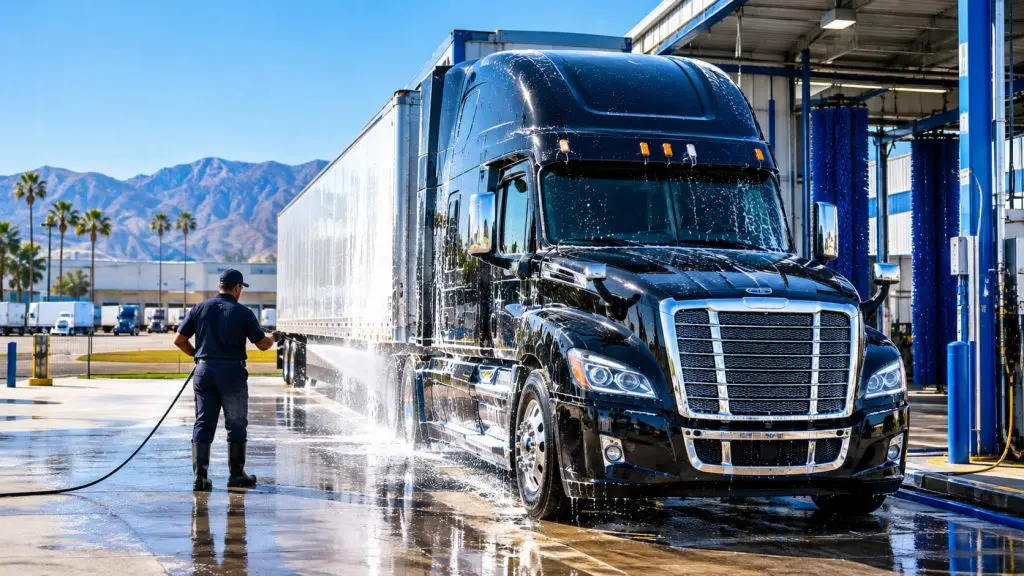
Tucked right into the buzzing freight corridor of San Bernardino County, Bloomington, California serves as a vital staging engine for the Inland Empire. Flanked by major interstates and bordered by expansive industrial parks, this pocket of Southern California handles thousands of cross-dock transfers, distribution staging runs, and intermodal drayage trips every single day. For warehouse fleet managers operating in and around Bloomington, keeping trailers moving and tractors turning is the daily priority.
Yet, there is one constant challenge every local logistics operator battles: thick, unrelenting grime. Between the particulate soot from Interstate 10, fine dirt kicked up from nearby material yards, and heavy brake dust generated by stop-and-go metro traffic, Bloomington fleet assets get coated in road film rapidly.
When your schedules are timed down to the minute, dispatching a tractor miles out of route for a cosmetic wash feels like wasted revenue. That is where on-demand, fast-turnaround truck washing services enter the equation as a strategic operational advantage.
Situated just minutes down the road, our facility in Fontana serves as the immediate regional wash hub for Bloomington carriers. By pairing smart geographic access with high-efficiency washing, local warehouse fleets can protect their equipment, safeguard brand presentation, and pass roadside safety checks without dropping precious road time.
1. The Operating Environment: Why Bloomington Fleets Get Dirty Fast
Operating in the heart of the Inland Empire means your vehicles work in one of the most freight-dense transit zones in the United States. Bloomington-based fleets encounter a unique mix of harsh contaminants that cling tenaciously to clear coats, aluminum tanks, and trailer skins:
- Heavy Diesel Particulate Fallout: With hundreds of thousands of Class 8 rigs moving through the I-10, SR-60, and I-15 interchanges daily, the air carries a heavy concentration of airborne carbon soot. This soot settles onto horizontal cab roofs and trailer bulkheads, forming an oily, dark layer.
- Fine Industrial Dust & Aggregate: Surrounding industrial developments, container yards, and construction corridors generate abrasive mineral dust that settles deep into chassis rails and around fifth-wheel assemblies.
- Severe Brake Dust & Tire Grime: Local distribution trucks and yard switchers run through continuous acceleration and braking cycles. This mechanical friction throws hot metallic brake dust directly onto wheel barrels and suspension components.
When you allow this combination of soot, dust, and brake dust to sit on your vehicles, it does not remain a simple surface issue. Road heat bakes these minerals into the paint, causing clear coat oxidation and premature corrosion.
2. The Fontana Advantage: Immediate Proximity to Bloomington
For a Bloomington warehouse operation, the biggest obstacle to regular fleet cleaning is distance. Sending an asset an hour away introduces non-productive driver hours, burns unnecessary fuel, and complicates dispatch boards.
Because Fontana sits directly adjacent to Bloomington, fleet coordinators have a dedicated commercial wash facility positioned right along their primary freight paths. Drivers leaving staging yards on Cedar Avenue, Valley Boulevard, or Slover Avenue can easily route through our Fontana wash lanes before joining regional highway routes.
Whether your tractors are making short-haul deliveries into Los Angeles rail ramps or heading east toward distribution centers, a quick stop in Fontana ensures that your equipment hits the road in showroom condition. For regional carriers operating beyond the Inland Empire, our broader network ensures consistent wash quality across key Southwestern lanes:
- Hesperia: Perfectly placed along the high-desert climb of the Cajon Pass on the I-15 corridor.
- Barstow & Thousand Palms: Ideal desert waypoints designed to rinse off intense alkali dust, heat-fused insects, and high-temperature highway films.
- Eloy, AZ: A premier I-10 long-haul corridor stop built to serve interstate runs between Southern California and the greater Southwest.
3. Why On-Demand Speed Protects Your Bottom Line
In high-volume warehouse fulfillment, predictability is everything. An on-demand wash model means your drivers are not stuck idling in a disorganized queue for hours at a generic truck stop wash bay.
Commercial vehicle wash systems engineered specifically for heavy equipment move rigs through high-volume, calibrated wash bays in minutes. Industrial-grade delivery systems pump anywhere from 20 to 30 gallons of water per minute, thoroughly flushing away dirt instead of relying on slow, uncalibrated hand-wands.
By minimizing dwell time in the bay, warehouse logistics directors preserve vital driver Hours of Service (HOS) under electronic logging devices. That speed directly translates into more loads moved per shift.
4. Chemistry Over Abrasive Scrubbing: Protecting Modern Assets
Many warehouse operators worry that fast washing means harsh, damaging methods. That concern is valid if a wash bay relies on spinning nylon brushes that act like sandpaper against painted clear coats, or if it uses uncalibrated, highly caustic detergents that bleach polished aluminum wheels white.
Modern commercial truck washing services rely on calibrated chemical principles rather than physical friction:
- Two-Step pH Balancing: The vehicle is treated with a specialized low-pH pre-soak that neutralizes the static electrical bond between road dirt and metal. This is immediately followed by a high-pH soap that emulsifies greasy industrial soot and biological residues. When the two solutions meet, they produce a chemical “snap” that releases dirt without scratching the paint.
- Preserving Specialty Metals: Aluminum fuel tanks and custom wheels demand balanced cleaners that lift oxidation without causing the unsightly white haze associated with cheap washouts. To understand how proper chemical care protects these structural assets, take a look at The Importance of Aluminum Brightening for Commercial Trucks.
- Protecting Sensors & Electronics: Modern fleet tractors are packed with collision-avoidance radar domes, blind-spot detectors, and windshield camera arrays. Chemistry-driven washing cleans around these delicate sensors safely, eliminating the risk of water intrusion caused by blind, pinpoint 3,500-PSI blasting. This distinct focus is a key reason Why Trucks Require Different Cleaning Techniques Than Light-Vehicles.
5. Mitigating DOT Inspection Risks for Local Fleets
The California Highway Patrol (CHP) and DOT inspection teams operating across the Inland Empire monitor commercial vehicles closely. When your tractors roll out of a Bloomington distribution center, their visual presentation sets an immediate tone at roadside inspection points and weigh stations.
A tractor covered in oily road grime, dirty wheel hubs, and brake dust suggests an operation that defers basic mechanical upkeep. Officers know that operations neglecting exterior hygiene are statistically more likely to overlook worn brake linings, frayed air lines, or leaking wheel hubs.
Regular washing eliminates the simple, visible infractions that frequently invite unnecessary enforcement scrutiny:
- Clean, unobstructed USDOT numbers, CA numbers, and fleet tracking decals.
- Spotless, bright LED clearance lamps and brake lights that project full illumination.
- Dirt-free retroreflective conspicuity tape along trailer sides and rear swing doors.
By keeping your equipment clean, you project fleet discipline, helping your drivers pass scale checks faster and protecting your CSA safety scores.
6. Building a Structured Fleet Wash Schedule
Rather than waiting for drivers to complain about caked-on mud or dealing with dirty rigs during customer deliveries, high-performing logistics operations build washing into their regular dispatch calendar.
| Fleet Sector | Recommended Wash Frequency | Key Target Areas |
| Local Drayage & Yard Spotters | Weekly / Bi-Weekly | Chassis rails, wheel barrels, fifth-wheel plates |
| Regional Distribution Reefers | Every 7–10 Days | Exterior aerodynamic panels, sanitary interior washouts |
| Interstate Dry Vans | Bi-Weekly / Monthly | Tractor fairings, conspicuity markings, RO spot-free rinse |
Structuring regular wash visits around existing distribution patterns keeps asset maintenance predictable and ensures budgets stay controlled.
Keep Your Bloomington Fleet Road-Ready
In the fast-moving logistics network of Bloomington and the broader Inland Empire, your trucks are the physical face of your brand. A dirty, neglected fleet damages your corporate image, frustrates professional drivers, and invites regulatory delays.
With convenient access to dedicated, high-speed wash infrastructure right next door in Fontana, there is no need to let road grime slow down your distribution schedules.
Keep your equipment clean, compliant, and operating at peak performance. Route your Bloomington warehouse fleet through our LS Truck Wash Fontana facility today, and experience how efficient, professional commercial vehicle care keeps your business rolling forward.