Ask any owner-operator who just spent two hours drying off a Class 8 rig under the scorching sun, and they’ll tell you the most frustrating part of cleaning a truck isn’t getting the dirt off—it’s what gets left behind when the water dries. You stand back to admire a freshly washed dark blue cab, only to watch a crusty grid of chalky white water spots form across the doors, the polished aluminum tanks, and the massive chrome grille.
Those ugly white rings aren’t soap residue. They are mineral deposits—hard water ghost marks that lock onto your paint and clear coat. In the world of commercial heavy-duty transport, where a clean rig is a rolling billboard for your business, water spots make even the most expensive wash look like a cheap, half-hearted attempt.
That’s where high-tech water filtration comes in. The secret behind a true, showroom-quality finish without spending hours hand-drying a 53-foot trailer is Reverse Osmosis (RO) technology.
Whether your trucks are operating through the high-mineral water basins of Fontana or hauling freight past the desert sun in Eloy, AZ, understanding the science of RO filtration is the key to getting a spot-free finish every single time you use professional truck washing services.
1. The Hard Truth About Tap Water (TDS)
To understand why a spot-free rinse works, you first have to look at what’s actually coming out of a standard water hose. Groundwater across America is packed with naturally occurring minerals like calcium, magnesium, silica, and sodium. In the water treatment industry, this is measured as Total Dissolved Solids (TDS), expressed in parts per million (PPM).
When you wash a truck with standard municipal or well water, those minerals are completely dissolved in the liquid. You can’t see them while the truck is wet. But as the sun hits the metal and the pure H₂O evaporates into the air, those mineral solids are left behind on the surface.
Standard municipal water across California and Arizona can easily feature TDS levels anywhere from 200 to over 600 PPM. When thousands of tiny water droplets dry across a warm tractor-trailer, each droplet leaves behind a microscopic pile of rock-hard mineral dust. Over time, these mineral rings can actually etch into your clear coat and dull your brightwork permanently.
2. The RO Solution: Molecular Filtration
So how do we get rid of those invisible minerals before the water ever touches your truck? We turn to the science of Reverse Osmosis.
In simple terms, Osmosis is a natural process where water wants to flow toward higher mineral concentrations to balance things out. Reverse Osmosis forces that process backward using extreme mechanical pressure.
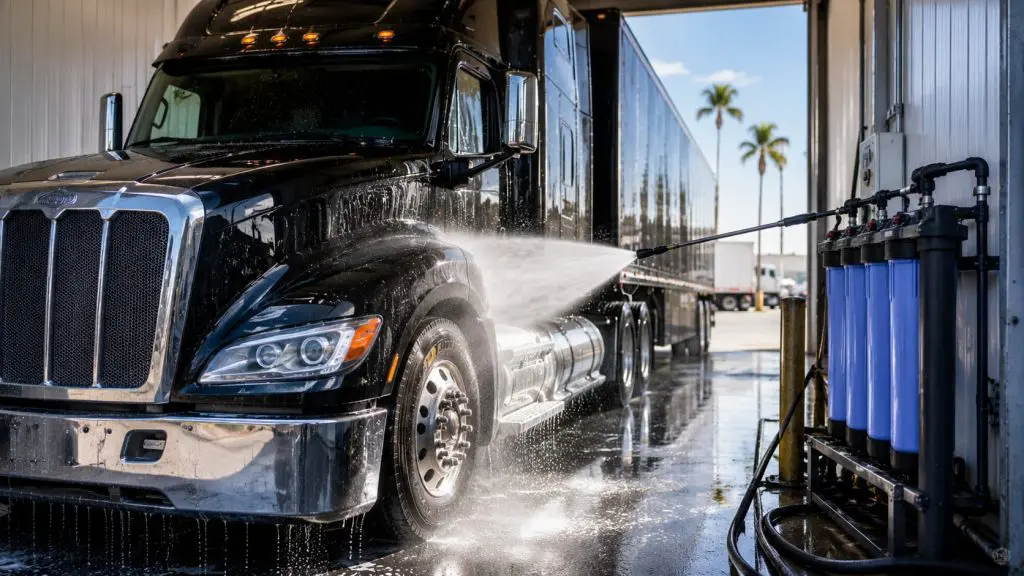
In a commercial RO filtration system, raw water is pumped under high pressure through a semi-permeable membrane. The pores in this specialized membrane are ridiculously tiny—about 0.0001 microns in size. To put that in perspective, a single human hair is about 70 microns wide.
Water molecules (H₂O) are small enough to pass right through the membrane pores. However, dissolved mineral ions like calcium, magnesium, and heavy metals are physically too large. They get trapped on the dirty side of the membrane and flushed away as wastewater, leaving behind pure, ultra-clean water with a TDS count near zero PPM.
3. Why Spot-Free Rinsing Changes Everything for Fleets
When a wash bay uses pure Reverse Osmosis water as its final rinse, the entire drying process changes:
Zero Hand-Drying Needed
Hand-drying a Class 8 tractor and 53-foot trailer takes immense labor and time—time that your drivers simply don’t have when fighting their ELD clocks. With a pure RO final rinse, the truck can air-dry naturally while rolling down the highway. As the water evaporates, there are literally zero mineral solids left behind to form spots.
Protection for Polished Aluminum and Chrome
Polished aluminum fuel tanks, custom wheels, and chrome stacks are extremely vulnerable to mineral etching and chemical staining. Hard water spots on raw aluminum can turn cloudy and require heavy mechanical re-polishing to fix. A spot-free RO rinse preserves that deep, mirror-like finish without harsh abrasives.
Crystal-Clear Visibility for ADAS and Mirrors
Modern trucks rely heavily on windshield-mounted cameras, radar lenses, and side-view mirrors. Hard water spots on a camera lens or windshield can distort the driver’s view and confuse Advanced Driver Assistance Systems (ADAS). A spot-free rinse ensures optical clarity across every piece of glass and sensor lens on the vehicle.
4. Combining RO Water with Advanced Wash Chemistry
RO water isn’t just great for the final rinse; it also makes soaps and detergents work significantly better.
Hard water minerals actively fight against soap. The calcium and magnesium in hard water bind to soap molecules, preventing them from foaming properly and forming a gummy residue known as “soap scum.” This forces low-quality wash bays to use higher concentrations of aggressive, caustic chemicals just to cut through the dirt.
By utilizing softened and purified water throughout the wash cycle, professional facilities can use milder, pH-balanced soaps. The soap foams richly, clings to road film, and breaks the “static bond” of the grime easily. This touchless, chemically balanced approach is a major reason Why Trucks Require Different Cleaning Techniques Than Light-Vehicles.
Strategic Route Planning: Finding Pure Water Along Your Lane
Installing and maintaining a commercial Reverse Osmosis system requires serious capital investment, heavy industrial pumps, and constant water quality monitoring. You won’t find pure RO rinses at a budget, quick-bucket roadside washout.
For fleet operators and independent drivers moving high-value loads across the Southwest, choosing a wash facility with high-grade RO technology is an essential part of keeping your equipment in peak presentation shape.
If your freight routes pass through key corridors in California and Arizona, LS Truck Wash provides precision, RO-powered cleaning at primary shipping hubs:
- Fontana & Hesperia: Strategically situated along the dense freight corridors surrounding the Los Angeles basin, designed to strip away port soot and finish with a spotless RO rinse before hitting the open highway.
- Barstow & Thousand Palms: Crucial desert stops where intense heat makes hard water spotting a massive issue. Our pure RO rinses ensure your paint air-dries clear even under the desert sun.
- Eloy, AZ: Positioned directly on the busy I-10 shipping lane, giving cross-country drivers a reliable spot to get a fast, spot-free wash that protects brightwork and clear coats.
Conclusion: The Science of a Flawless Finish
In the modern transportation market, presentation reflects professionalism. A truck covered in chalky, dried water spots looks neglected, no matter how much money you spent on the wash itself.
By harnessing the power of Reverse Osmosis and molecular filtration, you eliminate mineral spots at the source, protect your polished aluminum assets, and get your equipment back on the road faster.
Stop settling for hard water spots and dull finishes. Experience the difference that true water science makes. Pull your rig into an LS Truck Wash bay today, and let our Reverse Osmosis spot-free rinse give your truck the gleaming, showroom finish it deserves.