
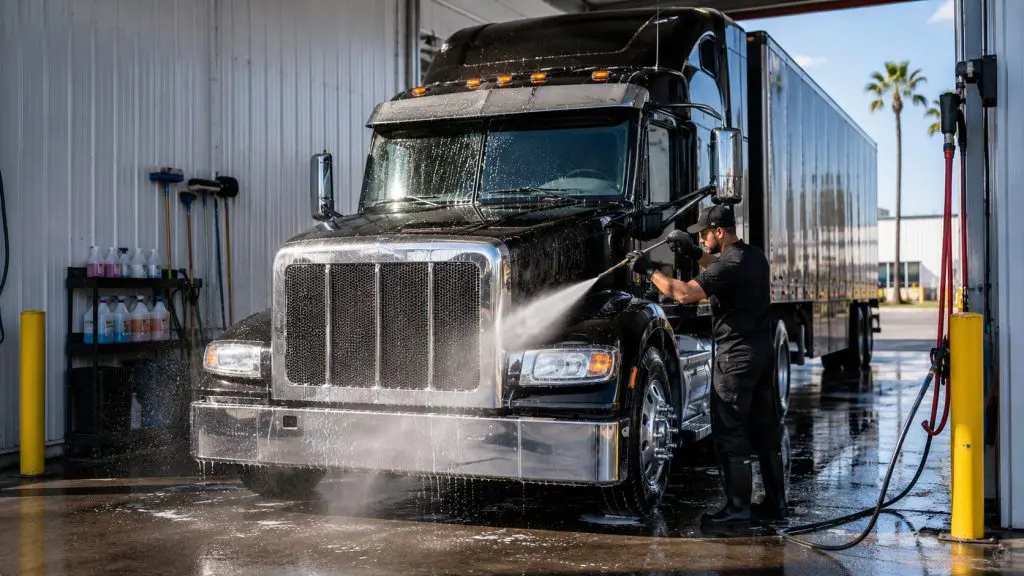
Ask any fleet manager or owner-operator running routes across the USA what keeps them up at night, and “CSA scores” will top the list. Managed by the Federal Motor Carrier Safety Administration (FMCSA), the Compliance, Safety, Accountability (CSA) program keeps a rolling, public scorecard of your operation’s safety performance.
A high CSA score isn’t just a bad grade on a report card. It is a direct financial hit. It triggers aggressive DOT roadside inspections, skyrockets your insurance premiums, and can cause high-end shippers to pull their contracts entirely.
When looking for ways to drop their points, most carriers jump straight to expensive electronic logging systems, major mechanical overhauls, or intensive driver training programs. While those are crucial, they miss the simplest, fastest, and most cost-effective compliance tool parked right in front of them: a professional truck wash.
Spending just fifteen minutes at a dedicated bay isn’t about vanity or fleet pride. It is a calculated risk-mitigation strategy. Here is the exact breakdown of how regular truck washing services keep your trucks moving and your CSA scores tracking downward.
1. The Behavioral Psychology of the Inspection Lane
Let’s start with the human element. State troopers and DOT inspectors standing at the weigh stations along major American freight corridors have to make rapid-fire decisions. With hundreds of commercial vehicles rolling past their booths every single hour, they can’t inspect them all. They rely on visual triggers to decide who gets a “pass” and who gets pulled around back for a grueling Level I or Level II inspection.
A truck caked in thick road film, heavy diesel exhaust soot, and dried mud screams structural neglect.
The inspector’s logic is simple: If the carrier doesn’t care enough to clean the equipment they can see, they probably aren’t maintaining the components they can’t see. A dirty truck functions as a massive visual warning sign that invites closer scrutiny.
Conversely, a rig that rolls up looking freshly detailed signals professional discipline. It tells the officer that you follow an organized maintenance program. If your equipment looks immaculate, an inspector is far more likely to give you a quick visual nod and clear you to hit the highway. By investing fifteen minutes in a wash bay, you are essentially pre-vetting your truck, minimizing the statistical likelihood of being selected for an inspection in the first place.
2. Eliminating the “Low-Hanging Fruit” Violations
When an inspector does choose to pull you over, they always start with the easiest visual violations. These are the “low-hanging fruit”—defects that require zero mechanical tools to spot. A shocking percentage of roadside violations are caused entirely by accumulated road grime:
Obscured License Plates and DOT Numbers
If a light layer of road salt, winter brine, or desert dust obscures even a single digit of your license plate or your USDOT registration numbers, you are looking at a mandatory fix-it ticket and immediate CSA points.
Dimmed and Blocked Lighting Systems
Modern LED lighting modules run cooler than old-school incandescent bulbs, meaning they don’t melt away frozen slush, mud, or road film. When your marker lights, turn signals, or tail lights are blanketed in dark highway soot, their reflective power drops dramatically. An inspector will write this up as an inoperable or obscured light every single time.
Reflective Tape Degradation
Federal regulations require commercial trailers to feature clean, high-visibility conspicuity tape (con-tape) along the sides and rear. When mud hides this tape, your trailer fails visibility compliance.
A standard 15-minute touchless wash clears all of these superficial compliance traps instantly. It ensures your legal identifiers and safety indicators are perfectly visible from a distance, preventing simple, preventable points from marring your carrier record.
3. Unmasking Critical Mechanical Defects Early
A high CSA score is frequently driven by vehicle maintenance violations—leaking wheel seals, cracked frame rails, frayed air lines, or out-of-adjustment brakes. The problem is that a heavy coat of road grease and undercarriage dirt acts like camouflage for these developing issues.
If your driver is doing their pre-trip inspection on a tractor-trailer covered in layers of old grease and road film, they can easily miss a hairline crack forming on a suspension component or a slow fluid leak pooling near the hubcap. But you can bet a DOT officer with a high-powered flashlight will find it.
By bringing your rig into professional truck washing services, you strip away this structural mask. A clean undercarriage allows your maintenance team and your drivers to spot defects during routine checks before the vehicle leaves the yard, giving you the chance to repair parts safely in a shop rather than paying for a roadside violation. To dive deeper into how heavy commercial machinery demands a specialized chemical wash format rather than basic high-pressure water to clear these sensitive mechanical spaces safely.
4. Keeping Advanced Safety Sensors Wide Open
Modern American fleets are heavily reliant on Advanced Driver Assistance Systems (ADAS). These suites use bumper-mounted radar blocks, side-view proximity sensors, and windshield-mounted cameras to track lane positioning and forward collision risks.
When your truck is tracking through heavy weather, these sensor faces get heavily blanketed by highway grime. If a radar cover or optical lens becomes obscured, the truck’s central computer will throw a system fault code, lighting up a warning indicator on the dashboard.
If you get pulled into an inspection lane with an active safety system fault glowing on your dash, the inspector can classify the truck as operating with defective safety equipment. Spending a few minutes to ensure these digital sensors are perfectly clear keeps your safety tech operational and your dashboard free of warning lights.
5. Neutralizing the Silent Corrosion Threat
For trucks frequently running the major interstate corridors of the USA, chemical road de-icers like magnesium chloride are a persistent structural enemy. These salts trap moisture directly against your steel frame rails, brake lines, and aluminum components.
If allowed to sit, these brines initiate deep structural pitting and rust. When a DOT inspector notes severe scaling or corrosion on load-bearing components or brake hardware, they will often issue an immediate Out-of-Service (OOS) order until the parts are replaced. A systematic, pH-balanced wash neutralizes these acidic salts completely, washing them out from the hard-to-reach pockets of your chassis. This chemical preservation is especially vital for preventing raw aluminum components from oxidizing and degrading.
Strategic Route Alignment: Maintaining Compliance on the Open Road
Lowering your CSA score requires consistent, strategic execution. A single truck wash once a month won’t protect your record if your trucks are running hundreds of miles through changing weather every day. You need a structured operational system supported by highly accessible wash facilities located right along your primary shipping lanes. For fleet managers looking to build a highly optimized, predictable cleaning program across their logistics network, check out our operational guide on How to Create an Efficient Fleet Wash Schedule.
If your drivers are navigating the heavily traveled transit lanes of the Southwest, LS Truck Wash provides fast, chemistry-driven, 15-minute fleet care across key locations:
- Fontana & Hesperia: Perfectly positioned right off the busy freight corridors entering and exiting the massive industrial hubs of Southern California, ideal for stripping off port grime and urban soot before passing the regional scale houses.
- Barstow & Thousand Palms: Strategic desert staging stops designed to rapidly wash away micro-abrasive sand, high-heat dust, and baked-on bugs that blind your ADAS sensors and dim your lighting systems.
- Eloy, AZ: Located directly along the high-traffic I-10 corridor, offering the ultimate mid-route sanctuary to neutralize cross-country road film and ensure your tractor-trailer looks immaculate before hitting the next state inspection point.
Conclusion: A Cleaner Rig Means a Safer Record
In the modern logistics landscape, cleanliness is directly tied to compliance. A dirty truck isn’t just an eye sore—it’s an open invitation for a lengthy roadside delay, expensive fines, and a damaged safety record.
Spending 15 minutes in a professional wash bay is one of the most effective, highest-return business investments you can make for your fleet. It alters the psychology of the inspection lane, wipes out simple visibility violations, unmasks hidden mechanical risks, and preserves your physical capital.
Don’t let road grime dictate your safety record. Take control of your compliance score from the outside out. Pull your rig into an LS Truck Wash location today, clear out the low-hanging violations, and roll through the scales with complete confidence.