In the vast logistics network of the United States, refrigerated trailers—commonly known as “reefers”—are the unsung heroes of our food supply chain. From the sprawling orchards of California to the distribution hubs in Fontana and the desert corridors of Eloy, AZ, these mobile cold-storage units carry billions of dollars worth of perishables every year.
However, transporting food isn’t just about maintaining the right temperature. It’s about maintaining biological integrity. A reefer trailer that looks clean to the naked eye can still be a breeding ground for bacteria, mold, and cross-contamination. This is where professional truck washing services transition from a matter of “fleet pride” to a matter of public health and legal compliance.
Here is why specialized reefer sanitization is the backbone of safe food transportation in the USA.
1. The FSMA Factor: Federal Oversight on Cleanliness
The Food Safety Modernization Act (FSMA) changed the game for American carriers. Under these regulations, the FDA places the burden of proof on the carrier to ensure that trailers are sanitary and do not present a risk of contamination.
When you pull into a facility in Barstow or Hesperia, a professional wash-out isn’t just about removing debris. It’s about creating a documented trail of sanitation. If a load of produce is rejected at a receiver’s dock due to “trailer odor” or “visible residue,” the financial hit falls squarely on the trucking company. By utilizing professional sanitization, you protect your business from the massive liability of a rejected load.
2. Beyond the “Visible”: Biofilms and Bacteria
The inside of a reefer is a unique environment. The constant moisture from condensation, combined with temperature fluctuations, creates the perfect “petri dish” for biofilms. A biofilm is a thin, slimy layer of bacteria that sticks to the corrugated walls and floors of the trailer.
Standard water pressure alone won’t touch a biofilm. It requires the “Scientific Snap” we’ve discussed in previous posts—a specific pH-balanced chemical approach that breaks down organic matter at a molecular level. This is a primary reason Why Trucks Require Different Cleaning Techniques Than Light-Vehicles; a car doesn’t have to worry about Listeria or E. coli hiding in its wheel wells or floor grooves.
3. The Cross-Contamination Trap
In the trucking industry, versatility is key. One day you might be hauling a load of raw poultry; the next, you’re scheduled for a load of fresh leafy greens. Without a high-grade professional wash-out, the risk of cross-contamination is astronomical.
Small spills, blood from meat packaging, or even the dust from soil can linger in the cracks of the trailer floor. When the reefer unit kicks on, the airflow circulates these particles throughout the trailer. Professional truck washing services utilize hot water and food-grade sanitizers to ensure that every square inch of the interior is neutralized before the next load is palleted.
4. Protecting the Equipment: Debris and Airflow
Reefer units are precision machines. To maintain a steady 34°F (1°C) or -10°F (-23°C), the unit requires unobstructed airflow.
- The Floor Channels: If the deep grooves in a reefer floor are filled with wood splinters from pallets, old shrink wrap, or dried product, the cold air cannot circulate under the cargo. This leads to “hot spots” in the load, which can cause premature spoilage.
- The Evaporator Coil: Dirt and dust from the road—especially in high-dust areas like Thousand Palms—can clog the unit’s intake.
Regular exterior and interior cleaning ensures that the mechanical components don’t have to work twice as hard to maintain temperature, extending the life of the reefer unit and saving you thousands in fuel and repair costs.
5. Odor Control and Receiver Reputation
Nothing gets a load rejected faster than a “funky” smell. Odors are often the first sign of bacterial growth. Even if the trailer looks spotless, a lingering smell of onions, fish, or dampness can seep into sensitive cargo like chocolate or eggs.
Professional washing facilities use specialized deodorizing agents that don’t just “mask” the smell with perfume but actually kill the odor-causing bacteria. This maintains your reputation with receivers across the USA. When you show up with a trailer that smells fresh and looks sanitized, you are signaling to the receiver that you are a high-tier professional.
The Anatomy of a Professional Reefer Wash-Out
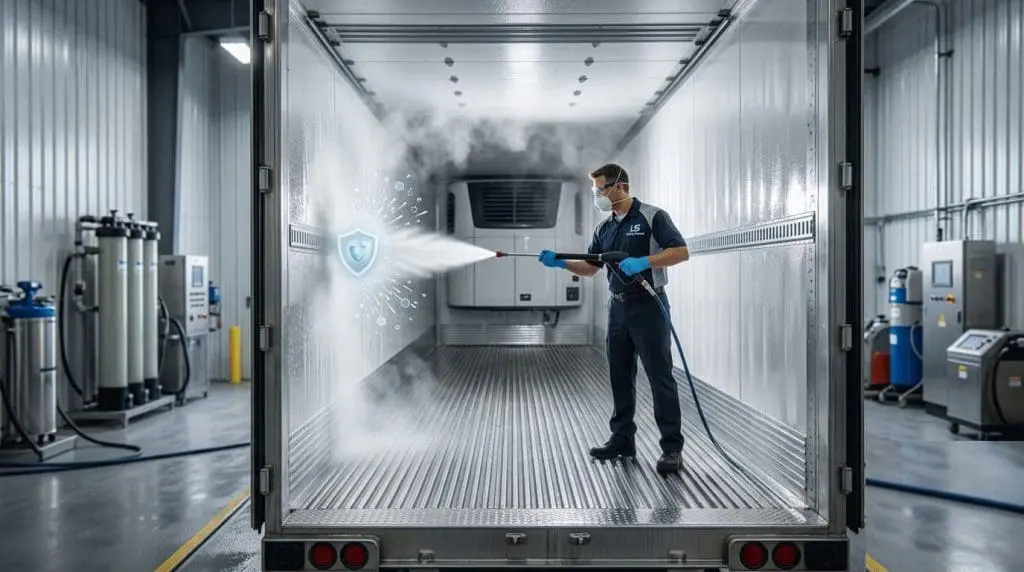
At LS Truck Wash, we follow a rigorous protocol for food-grade trailers:
- Debris Removal: Thoroughly sweeping and vacuuming out physical waste.
- High-Temp Rinse: Using heated water to melt away fats and greases.
- Sanitization Phase: Applying EPA-approved, food-safe sanitizers.
- The “Cracks and Crevices”: Paying special attention to the rear door seals and the front bulkhead where grime loves to hide.
- Exterior Protection: Ensuring the reefer’s exterior is free of road salt and grime that could lead to corrosion of the cooling lines.
The Economic Impact: Cleanliness as Profit
Let’s talk numbers. The cost of a professional reefer wash is a tiny fraction of the value of the cargo inside. A rejected load of high-end pharmaceuticals or fresh organic produce can cost a carrier upwards of $50,000 to $100,000.
In a world where margins are thin and fuel prices are volatile, you cannot afford the “tax” of a rejected load. Furthermore, a clean, well-maintained trailer has a higher resale value and suffers less downtime due to mechanical failure. If you’re looking to optimize your fleet’s performance, consistency is your best friend.
Conclusion: Serving The American Table
When we wash a reefer at our locations in California or Arizona, we aren’t just cleaning a trailer; we are protecting the food that ends up on American dinner tables. We are the gatekeepers of food safety, ensuring that the cold chain remains unbroken and uncontaminated.
In the high-speed, high-stakes world of USA logistics, don’t let a dirty trailer be the weak link in your chain. Trust the professionals who understand the science of sanitation and the regulations of the road.
Ready to secure your next load? Visit LS Truck Wash’s detailing center today. Whether you’re coming off a long haul through the desert or prepping for a pickup in the valley, we’ll make sure your reefer is FSMA-ready and showroom-clean.