Ask any old-school driver how to get a rig clean, and they’ll probably point you toward a stiff brush and a lot of sweat. For years, the industry relied on “elbow grease” as the gold standard. But here’s the thing: in 2026, the chemistry of road grime has changed, and our cleaning methods had to catch up.
If you’re still relying on heavy scrubbing, you’re likely working harder, not smarter. More importantly, you might be slowly destroying your truck’s finish. The real winner in modern fleet maintenance isn’t friction—it’s the “Two-Step” Scientific Snap.
The Hidden Enemy: The “Static Bond”
Most people think road film is just dirt. It’s not. It’s a microscopic cocktail of diesel exhaust, tire rubber, and mineral deposits. These particles don’t just sit on your paint; they are held there by a literal static charge.
Think of it like a magnet. When you try to scrub it off, you’re trying to physically break an electrical bond. That friction creates micro-scratches—often called “swirl marks”—in your clear coat. These scratches act like tiny valleys where more dirt can settle, making the truck even harder to clean next time.
How the “Snap” Works (Without the Brushes)
The two-step method replaces the brush with a two-part chemical reaction. It’s essentially “ph-balancing” the grime right off the metal.
- Phase One: The Low-pH Pre-Soak We start with a specialized acidic solution. This isn’t about “eating” the paint; it’s a surfactant that targets inorganic stuff—think road salt and oxidation. Its main job? To neutralize that static charge.
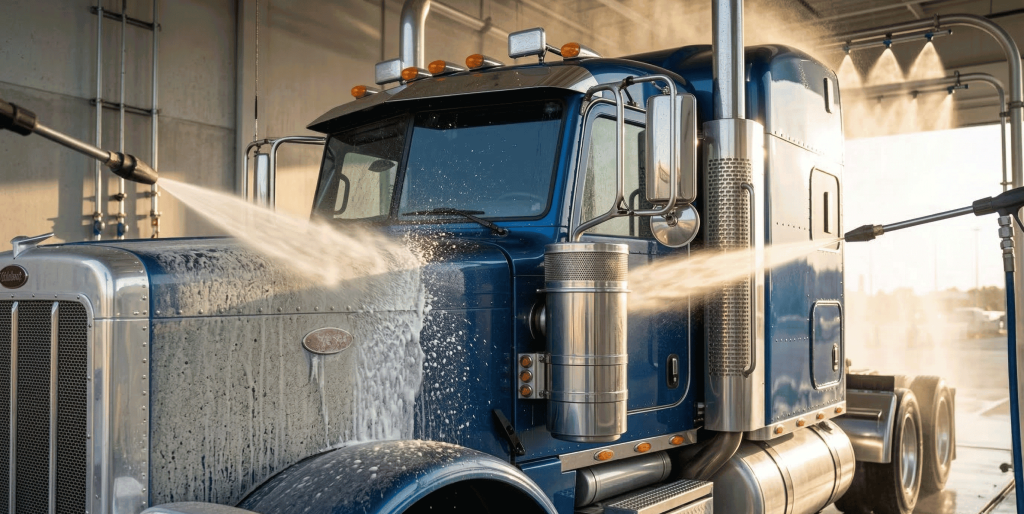
- Phase Two: The High-pH Alkaline Soap While the truck is still wet from step one, we apply a high-pH alkaline soap. This goes after the organic gunk—grease, oil, and the bugs from your last cross-country run.
The Result: When that high-pH soap hits the low-pH pre-soak, it creates a “snap” reaction. The dirt is physically lifted and suspended in the foam. You simply rinse it away. No bristles, no scratches, just clean.
Why Science Beats a Brush Every Time
- Zero “Shadowing”: Brushes can’t get behind rivets, under fairings, or into the tight spaces around fuel tanks. Chemistry goes everywhere. If the liquid can touch it, it’s getting cleaned. This is one reason Why Trucks Require Different Cleaning Techniques Than Light-Vehicles.
- Saving Your Shine: Constant scrubbing dulls the paint. A “touchless” two-step wash keeps your fleet looking showroom-ready for years. This is especially vital for your aluminum. To see how to keep your metal from pitting or clouding.
- Speed is Money: A manual scrub is an all-day affair. A professional two-step truck washing service gets you in and out in minutes. In this business, if the wheels aren’t turning, you aren’t earning.
- Fighting Corrosion: Brushes don’t neutralize road salt; they just move it around. The pH-balanced method actually neutralizes the corrosive brines used on USA highways before they can start eating your wiring harnesses.
The Bottom Line
Modern trucks are aerodynamic, high-tech machines. They deserve better than a bucket and a brush. Using a pH-balanced wash isn’t just about looking good—it’s about protecting the longevity of your asset.
By shifting to a scientific approach, you’re reducing downtime and maintenance costs simultaneously. If you’re managing multiple units, you know how hard it is to stay consistent. For help with that, read our breakdown on How to Create an Efficient Fleet Wash Schedule.
Conclusion
Stop fighting the road film and start using the science of the “snap.” Your paint will thank you, and your wallet will too.
Ready to see the difference chemistry makes? Swing by LS Truck Wash and let us show you why the “Two-Step” is the only way to roll. We’ll get you back on the road faster, cleaner, and protected.